While Vision-Language-Action (VLA) models enable flexible action generation, their generalization across diverse environmental elements, including manipulated objects, destinations, and backgrounds, is limited by the lack of diversity in robotic training data. Trained end-to-end on such data, VLAs tend to exploit visual shortcuts, associating actions with task-irrelevant visual features rather than the intended task semantics. These shortcuts block recomposition of elements already seen by the policy, that is, compositional generalization. Existing approaches mitigate such entanglement through task-relevant perception or targeted data diversification, but offer no explicit mechanism for unseen recomposition and require backbone-specific modifications with retraining. We observe that under such recomposition, VLAs often fail at global grounding while retaining local manipulation skills that recover near the correct target in familiar configurations. Therefore, we propose Referential Guidance (ReGuide), a training-free wrapper that, given object poses from a grounding module, combines semantic and geometric rebinding to guide the end-effector into demonstration-supported configurations of the instructed referent, where the frozen policy can resume execution. Experiments in simulation across multiple VLA backbones as well as on a real robot show that ReGuide improves success rates under compositional shifts by up to 56.8 and 75.0 percentage points, respectively, while preserving standard-task performance.
This publication proposes a definition and a classification of agile software development approaches and analyses ten software development methods that can be characterized as being "agile" against the defined criterion.
P. Abrahamsson, O. Salo, Jussi Ronkainen et al.· arXiv.org· 727 citations· ⚡54
The study shows that agile practices improve both informal and formal communication, but indicates that, in larger development situations involving multiple external stakeholders, a mismatch of adequate communication mechanisms can sometimes even hinder the communication.
M. Pikkarainen, Jukka Haikara, O. Salo et al.· Empirical Software Engineeri...· 401 citations· ⚡48
The results indicate that software engineering work practices are chosen opportunistically, adapted and configured to provide value under the constrains imposed by the startup context.
Nicolò Paternoster, Carmine Giardino, M. Unterkalmsteiner et al.· Information and Software Tec...· 394 citations· ⚡54
The possibility of inferring high-dimensional data inference in a model that consists of a prior and an auxiliary differentiable constraint given some additional information is considered, thereby allowing a range of potential applications in adapting models to new domains and tasks.
Alexandros Graikos, Esmeralda S. Whitammer, N. Jojic et al.· Neural Information Processin...· 316 citations· ⚡15
It is proved that any global minimizer of the trajectory balance objective can define a policy that samples exactly from the target distribution, and empirically demonstrate the benefits of the trajectories balance objective for GFlowNet convergence, diversity of generated samples, and robustness to long action sequenc...
Esmeralda S. Whitammer, Moksh Jain, Emmanuel Bengio et al.· Neural Information Processin...· 302 citations· ⚡60
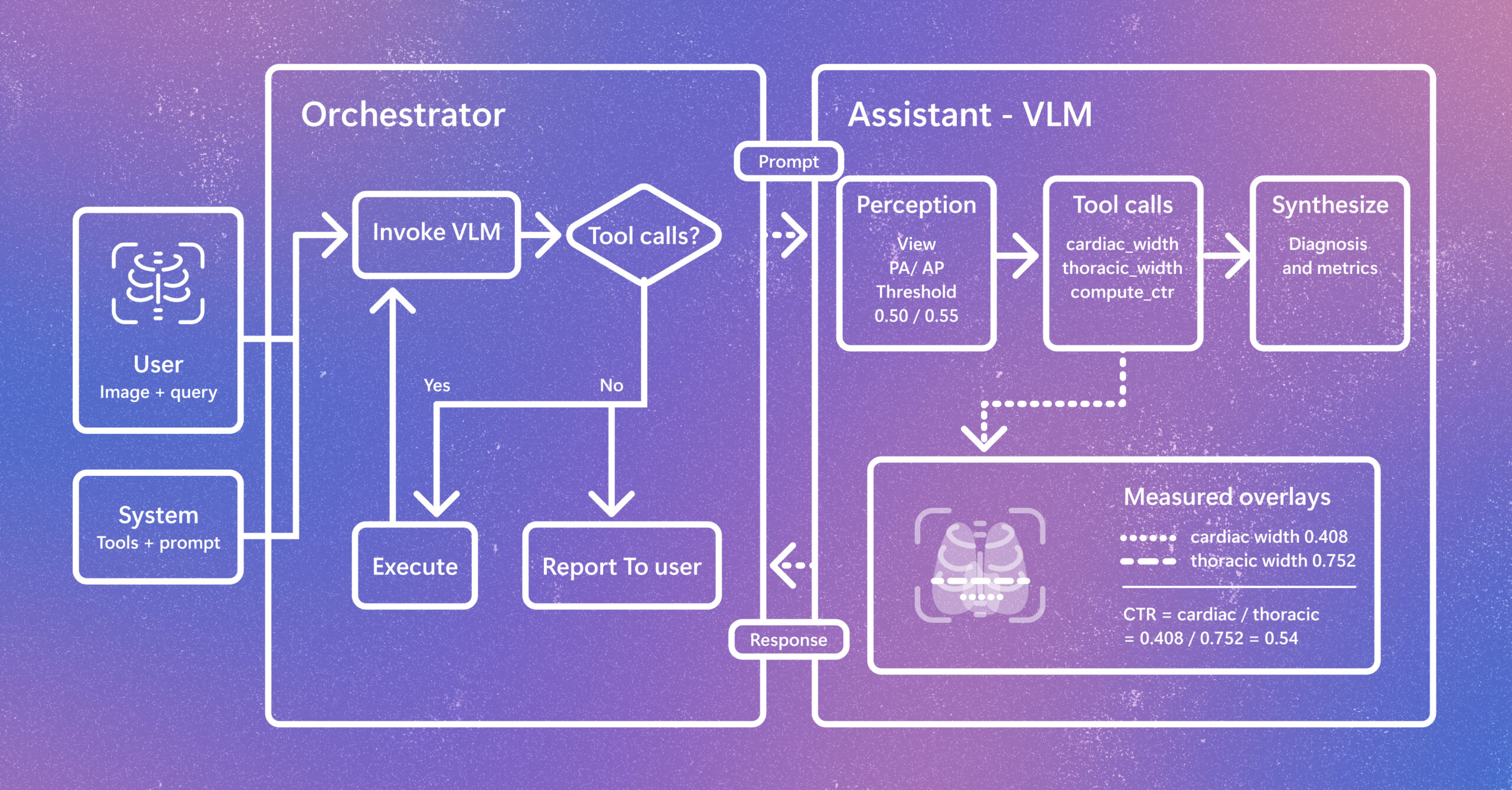
Radiology AI is evolving beyond report generation. CARE-X explores a unified approach that combines flexible reasoning, calibrated predictions, and measurement-based tools for chest X-ray interpretation. The post Introducing CARE-X: Towards Clinically Useful Radiology VLMs with Auxiliary Supervision, Reward-Aligned Learning, and Tool-Augmented Measurement appeared first on Microsoft Research.