Sep 2026· Applied and Computational Engineering· 0 citations
Topic Modeling
TL;DR
The research findings show that RL has gradually expanded from simply improving the accuracy of the final answer to optimizing queries, multi-round search, process decision-making and trustworthy screening, providing new ideas for enhancing the active retrieval ability of RAG and improving the credibility of information.

Abstract
Retrieval-augmented generation (RAG) enhances large language models (LLMs) by incorporating external information, but traditional fixed retrieval processes struggle to adapt to complex task requirements. In recent years, reinforcement learning (RL) has been increasingly applied to train LLMs to autonomously invoke search tools, driving RAG to evolve from the passive information acquisition of a fixed pipeline to a trustworthy retrieval system with autonomous decision-making capabilities. This paper reviews the representative studies on the combination of LLMs, RAG and RL in recent years. It focuses on analyzing the role of RL in dynamic retrieval, process rewards, query optimization, etc., and compares the connections and evolutionary relationships among different methods. The research findings show that RL has gradually expanded from simply improving the accuracy of the final answer to optimizing queries, multi-round search, process decision-making and trustworthy screening, providing new ideas for enhancing the active retrieval ability of RAG and improving the credibility of information.
The review finds that RAG can improve knowledge accuracy and timeliness by grounding responses in retrieved evidence and allowing knowledge resources to be updated independently of the base model.
This paper presents an adaptive knowledge-augmented framework for Mizo Large Language Models by combining Retrieval-Augmented Generation (RAG) with continual learning that harnesses semantic retrieval with dense embeddings and FAISS indexing, adaptive evidence re-ranking, parameter-efficient fine-tuning, and incrementa...
Vanlalropuia Ralte, Abhisake Sinha· International Journal For Mu...· 0 citations
Retrieval-Augmented Generation (RAG) has become a fundamental paradigm for enhancing Large Language Models (LLMs) with external knowledge. However, while recent structure-augmented approaches organize documents into graphs to improve information access, their retrieval strategies remain largely static, relying on simil...
Jinghong Lei, Wang Kun, Zhigang Chen et al.· Proceedings of the 32nd ACM...· 0 citations
A systematic literature review on how RL are adapted and scaled as a fundamental post-training tools and how innovations in the RL pipeline enhance the domain-specific LLMs is conducted.
Qianyue Hao, Lin Chen, Xiao-Qian Qi et al.· ACM Computing Surveys· 1 citation
Multi-Objective In-context Knowledge Editing (MO-IKE), a multi-objective RL algorithm that formulates prompt construction for in-context knowledge editing as a Constrained Markov Decision Process, enabling more balanced and globally coherent prompt construction.
Xu-Zhong Wang, Maiqi Jiang, Tejal Nair et al.· 1 citation
This tutorial provides an in-depth treatment of modern RAG based on AI-facilitated systematic analysis of ~2000 recent papers (2020--2026) and traces the RAG pipeline from its modular foundations through graph-enhanced reasoning to the latest RL-driven agentic architectures, covering each stage.
Xin Dong, Sanat Sharma, Kai Sun et al.· Proceedings of the 32nd ACM...· 0 citations
What does it take to trust AI-driven HVAC optimization? Our AI Model Factory combines agents, machine learning, reinforcement learning and deterministic checks in a governed workflow designed for messy, real-world building data. The post We built an AI factory for HVAC control appeared first on GPT-Lab.
MIT News · Artificial Intelligence· news.mit.eduAug 18, 2026
A new method for surgically removing training examples from a model reveals that as datasets grow, the link between what a model learns and what it produces dissolves.
Microsoft Research Blog· microsoft.comJul 30, 2026
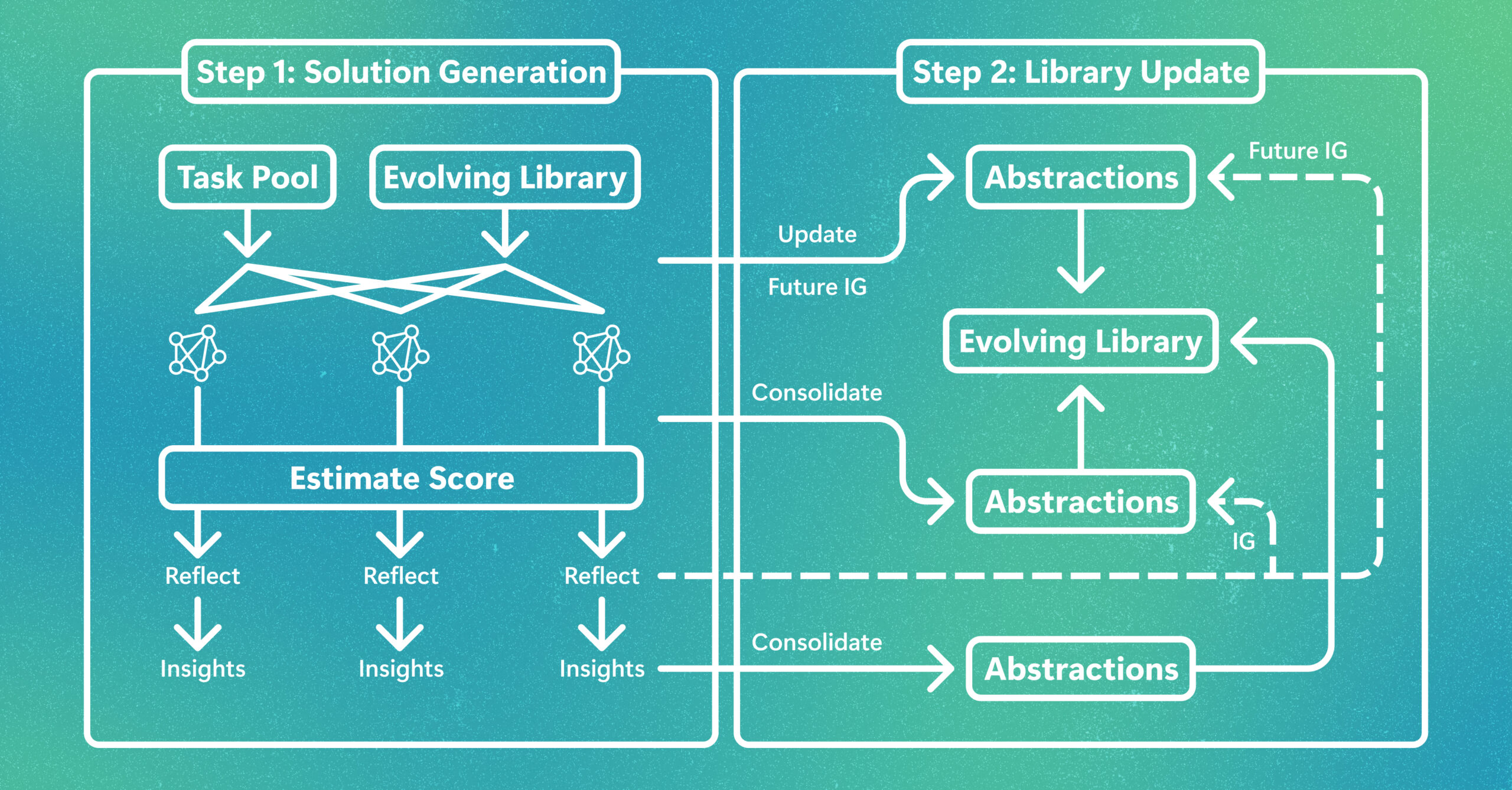
LLMs do not get smarter just by remembering more. EvoLib turns experience into evolving knowledge, taking reusable skills and insights that help models learn and adapt across tasks long after deployment. The post EvoLib: Turning experience into evolving knowledge appeared first on Microsoft Research.
MIT News · Artificial Intelligence· news.mit.eduMay 20, 2026