Sep 2026· IEEE Transactions on Neural Networks and Learning Systems· Vol PP· 0 citations
Medicine
TL;DR
RGLLA-PPIS, a novel multimodal prediction model that integrates retrieval-augmented learning and residual GNNs for PPIS identification, outperforms several state-of-the-art baselines in both accuracy and robustness and demonstrates its potential to guide real-world protein engineering tasks.
Abstract
Accurate prediction of protein-protein interaction sites (PPISs) plays a crucial role in understanding protein function, elucidating disease mechanisms, and facilitating drug target discovery. Although conventional approaches based on sequence or structural features have shown promising results, they still face several challenges. These challenges include oversmoothing in deep graph neural networks (GNNs) and poor generalization to domain-specific data. To address these issues, we propose RGLLA-PPIS, a novel multimodal prediction model that integrates retrieval-augmented learning and residual GNNs for PPIS identification. In RGLLA-PPIS, protein graphs are constructed by combining AlphaFold3 (AF3)-predicted protein structures with multiple sequence-derived features. To effectively capture both local and global spatial dependencies, the model employs equivariant GNN (EGNN) and GCN modules with residual connections, which help alleviate the oversmoothing problem and preserve node-level variability. Moreover, during prediction, we used the retrieval-augmented knowledge provided by the pretrained protein language model (PLM) Evolla and ChatGPT-4o to construct semantic priors to supplement potential functional site information and enhance the generalization capacity of the prediction model. Extensive experiments on benchmark datasets show that RGLLA-PPIS outperforms several state-of-the-art baselines in both accuracy and robustness. Furthermore, comparison with wet-lab results on a domain-specific protein system reveals a strong correspondence between experimental functional sites and the high-probability regions predicted by RGLLA-PPIS. This demonstrates the model's potential to guide real-world protein engineering tasks. The source code can be found at: https://github.com/MiJia-ID/RGLLA-PPIS.
This work presents HGRL-PPIS, a novel hierarchical graph representation learning approach for predicting protein-protein interaction sites that achieves superior performance over competing methods on multiple benchmark datasets, enabling more reliable detection of protein-protein binding residues.
This work proposes ARF-GNN, an adaptive receptive field graph neural network tailored for protein function prediction, which dynamically models structural context via hierarchical multi-hop neighborhood aggregation and introduces a dual-branch meta-learning framework.
Zhiqiang Hui, Weizhong Lu, Yi-Yi Xia et al.· Computational biology and ch...· 0 citations
Accurate identification of protein-protein interactions (PPIs) is fundamental for understanding cellular mechanisms and facilitating drug discovery. Although high-throughput experimental methods have expanded the known interactome, they remain resourceintensive and prone to noise. Consequently, computational approaches...
Pantelis Makrygiannis, Nikitas-Rigas Kalogeropoulos, Agorakis Bompotas et al.· International journal on art...· 0 citations
DHST is proposed, a deep hybrid structure–topology framework that integrates sequence semantics from a pretrained protein language model with local structural information learned by a residual graph convolutional network and introduces site-specific persistent homology to encode multi-scale topological invariants and a...
Bin Lu, Fujun Xiang, Hai-Long Wang et al.· Applied Sciences· 0 citations
MOTIVATION
The identification of compound-protein interactions (CPIs) is crucial in the early stages of drug discovery. However, machine-learning (ML)-based methods based on one- and two-dimensional representations cannot capture important geometric information on the binding sites of CPIs, which limits their predictiv...
Assistant Professor Pat Pataranutaporn describes a new interface that lets everyday users glimpse inside an AI's neural network before their chatbot ever says a word.
Microsoft Research Blog· microsoft.comJul 13, 2026
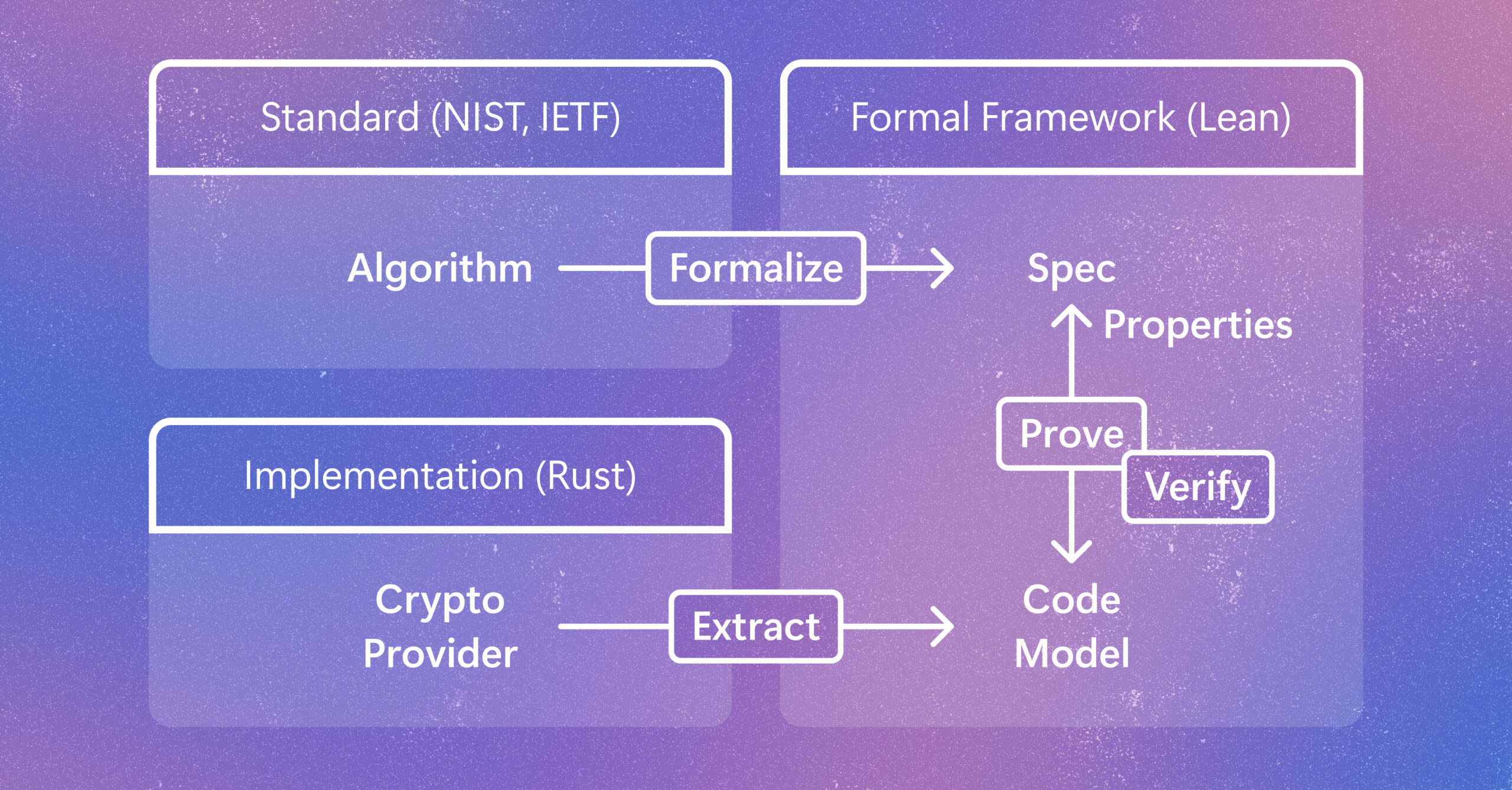
Cryptographic code supports vital protections in modern computing systems. Learn how a new method helps verify code as developers write it while preserving speed and adaptability as it gets implemented and evolves. The post Verifying Rust cryptography in SymCrypt, from standards to code appeared first on Microsoft Research.
MIT News · Artificial Intelligence· news.mit.eduJul 6, 2026
PhD student Rachel Sava, winner of the Envisioning the Future of Computing Prize, explores transformative improvements and dystopian risks of neural technology.