SimpleMemVLA, a VLA without a dedicated memory module that uses the backbone's native video context directly as memory, achieves state-of-the-art results on four memory benchmarks without loss on general-purpose control, and with the same backbone and training setup it outperforms retrieval, compression and recurrent-state methods by a wide margin.
Abstract
Long-horizon manipulation is partially observable: the information needed to choose the next action may appear only in observations from minutes earlier. Existing memory mechanisms for VLAs, such as retrieval banks, learned compressors and recurrent states, must decide what to keep from the past before knowing what a future decision will require. They were motivated by the assumption that minute-scale history is too large to process directly, which no longer holds for modern VLM backbones. We propose SimpleMemVLA, a VLA without a dedicated memory module that uses the backbone's native video context directly as memory. It keeps the sampled history intact in the timestamped video format the backbone was pretrained to process, routes the evidence it finds to a standard flow-matching action head through the hidden states of a generated sub-task, and prefills the history shared by consecutive decisions during action execution, keeping latency close to that of a single-frame VLA. SimpleMemVLA achieves state-of-the-art results on four memory benchmarks without loss on general-purpose control, and with the same backbone and training setup it outperforms retrieval, compression and recurrent-state methods by a wide margin. History interventions show that the policy reads specific evidence from its past and follows edited histories without parameter updates, a visual form of in-context learning. On a physical dual-arm robot, it completes two tasks whose decisive evidence disappears before the robot acts. Code available at https://github.com/OpenBMB/SimpleMemVLA
SmoLSTM couples a frozen 256M-parameter SmolVLM backbone to a matrix-memory LSTM control layer in which observation tokens and action queries are unified in a single causal stream that is never reset throughout the entire episode, capturing the episode in a recurrent state.
This work proposes StateMem, a single-state residual memory framework for VLA policies that uses prediction error to update a persistent memory token through low-rank residuals and to adaptively route cached prefixes.
Vision-language models are increasingly used to understand long videos and continuous streams. However, dense visual tokens accumulate with video duration, making long-context inference prohibitively expensive. Existing training-free visual-token selection methods reduce this cost by retaining informative tokens, but m...
Zi-Han Chen, Xuejian Rong, Xiao-Juan Wang et al.· 0 citations
Recurrent Action Memory (RAM) is proposed, a lightweight module that conditions action prediction on previous action tokens, providing temporal context critical for manoeuvres such as overtaking and emergency braking.
Kemal Oksuz, Alexandru Buburuzan, Yu-Han Yao et al.· 0 citations
UniMem is presented, a framework that unifies high-level, multimodal memory and low-level control under one backbone that outperforms fixed-interval image sampling baselines in simulation and hierarchical baselines in hardware, while offering faster inference and a simple training pipeline for easy adoption.
Lars W. Osterberg, M. Wang, Mac Schwager· 1 citation
VideoHarness-RSI is introduced, a controlled framework that recursively searches executable context constructors around a frozen VLM while keeping the answering model and interface fixed and establish executable context construction as a distinct optimization layer and provide an auditable baseline for studying harness...
Exploring how generative AI could make machine vision more accessible to businesses. The post GenEye in a Box: Making Machine Vision Something You Can Just Ask For appeared first on GPT-Lab.
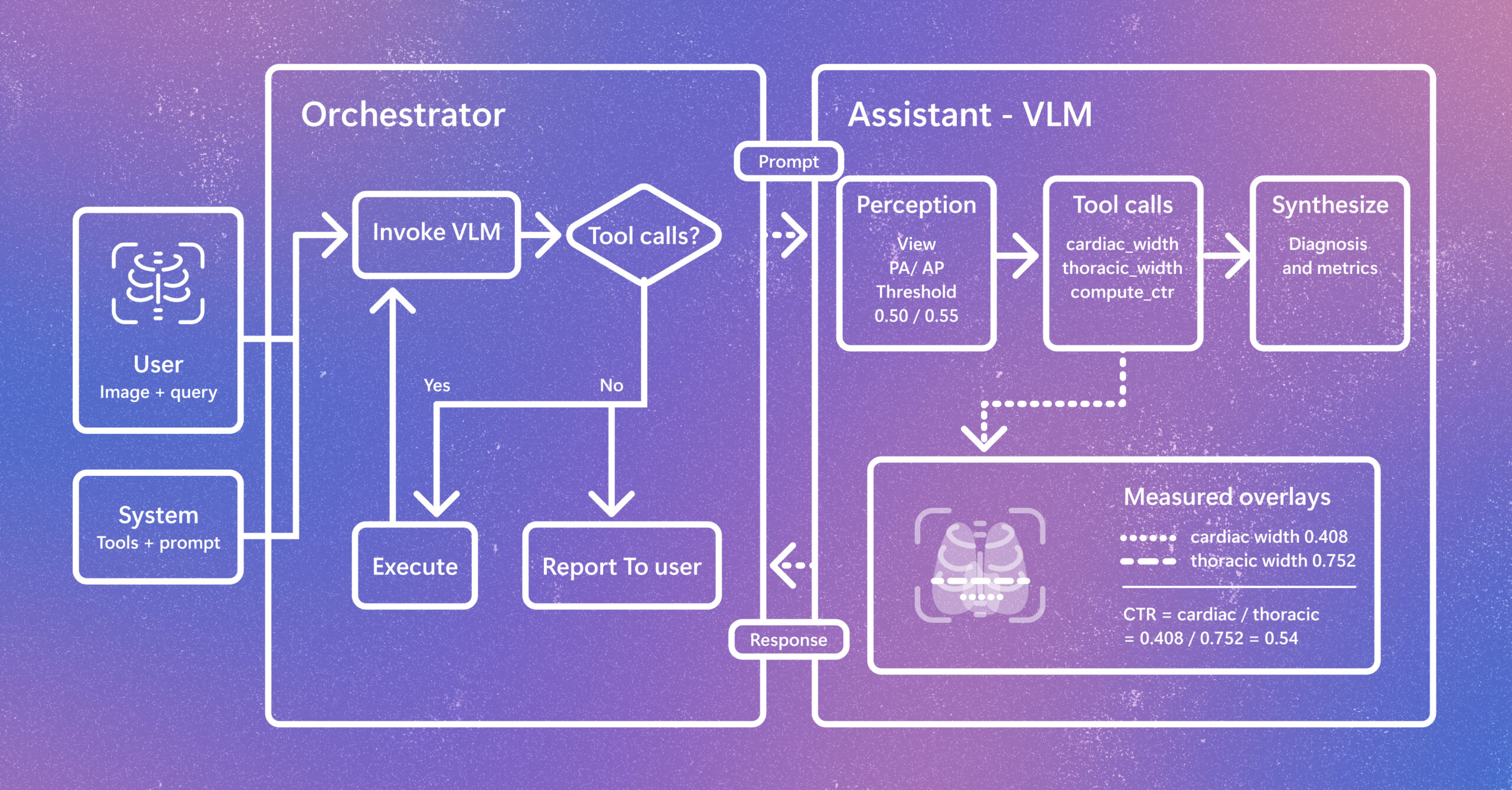
Radiology AI is evolving beyond report generation. CARE-X explores a unified approach that combines flexible reasoning, calibrated predictions, and measurement-based tools for chest X-ray interpretation. The post Introducing CARE-X: Towards Clinically Useful Radiology VLMs with Auxiliary Supervision, Reward-Aligned Learning, and Tool-Augmented Measurement appeared first on Microsoft Research.