This work addresses leakage through a learned obfuscate-and-recover scheme that protects participants' private datasets while still allowing an independently deployable model to be trained on the server side, making split-based federated LLM fine-tuning practically viable.
Abstract
Fine-tuning large language models (LLMs) on domain-specific data is essential for downstream adaptation. In many deployments, a participant cannot hold the complete model locally. This happens because the model owner keeps the full model proprietary, or because the participant lacks sufficient compute resources. Split Learning (SL) addresses this by partitioning the model between the participant and a server so that only a small portion runs locally. When the underlying data is additionally distributed across multiple institutions with privacy requirements, Federated Learning (FL) further enables collaborative training across participants by sharing only model updates instead of raw data. In this combined setting, each client transmits intermediate activations to the server, and for LLM fine-tuning, this exchange poses an inherent privacy paradox. The autoregressive nature of LLMs causes the transmitted activations to leak the input, and existing perturbation-based defenses are fundamentally ineffective in this setting. We address this leakage through a learned obfuscate-and-recover scheme that protects participants'private datasets while still allowing an independently deployable model to be trained on the server side. Experiments demonstrate that our approach achieves strong privacy protection with modest utility loss and system overhead, making split-based federated LLM fine-tuning practically viable.

Federated low-rank adaptation (FedLoRA) allows multiple clients to collaboratively fine-tune large language models (LLMs) on downstream tasks without exposing their private data. To mitigate privacy leakage during aggregation, differential privacy (DP) is widely used to clip and perturb local model updates with noise,...
Nan Yan, Yu-Qing Li, Xiong Wang et al.· Proceedings of the 32nd ACM...· 0 citations
This work identifies and characterize the Depth-Performance Dilemma: the regime that maximizes system efficiency is precisely where fine-tuning quality collapses, and challenges the prevailing assumption that partition depth is a utility-neutral tuning knob and provide a structural foundation for stable distributed LLM...
Cloud-based large language models (LLMs) require users to disclose plaintext data to service providers, creating privacy risks in sensitive domains. Existing privacy-preserving approaches often trade utility for protection, incur substantial computational or communication overhead, remain vulnerable to reconstruction f...
Jeongho Yoon, Chanhee Park, Yong-Chan Chun et al.· 0 citations
Federated learning (FL) enables multiple clients to jointly train a model without sharing raw data. Decentralized federated learning (DFL) further removes the need for a trusted central coordinator in the aggregation process. However, in decentralized settings, model aggregation is vulnerable to inference and poisoning...
Yi-Cheng Huang, Zhou Zhou, You-Liang Tian et al.· Journal of King Saud Univers...· 0 citations
Cloud-based Large Language Model (LLM) inference services typically require users to submit plain-text inputs, thereby posing severe privacy risks. Existing privacy-preserving paradigms are mostly task-specific and often necessitate pervasive modifications to the entire server-side model. This reliance introduces subst...
Wentao Zhong, Yu-Ting Li, Di-Cong Yu et al.· IEEE Transactions on Informa...· 0 citations
Adaptive AI agents can help make BIM data more machine-readable by navigating IFC models, interpreting inconsistent information, and mapping it to defined standards. In this blog, Alok Rawat shares findings from a real-world pilot in construction workflows. The post Adaptive AI Agents in Construction Workflows appeared first on GPT-Lab.
What does it take to trust AI-driven HVAC optimization? Our AI Model Factory combines agents, machine learning, reinforcement learning and deterministic checks in a governed workflow designed for messy, real-world building data. The post We built an AI factory for HVAC control appeared first on GPT-Lab.
MIT News · Artificial Intelligence· news.mit.eduAug 18, 2026
A new method for surgically removing training examples from a model reveals that as datasets grow, the link between what a model learns and what it produces dissolves.
Microsoft Research Blog· microsoft.comJul 30, 2026
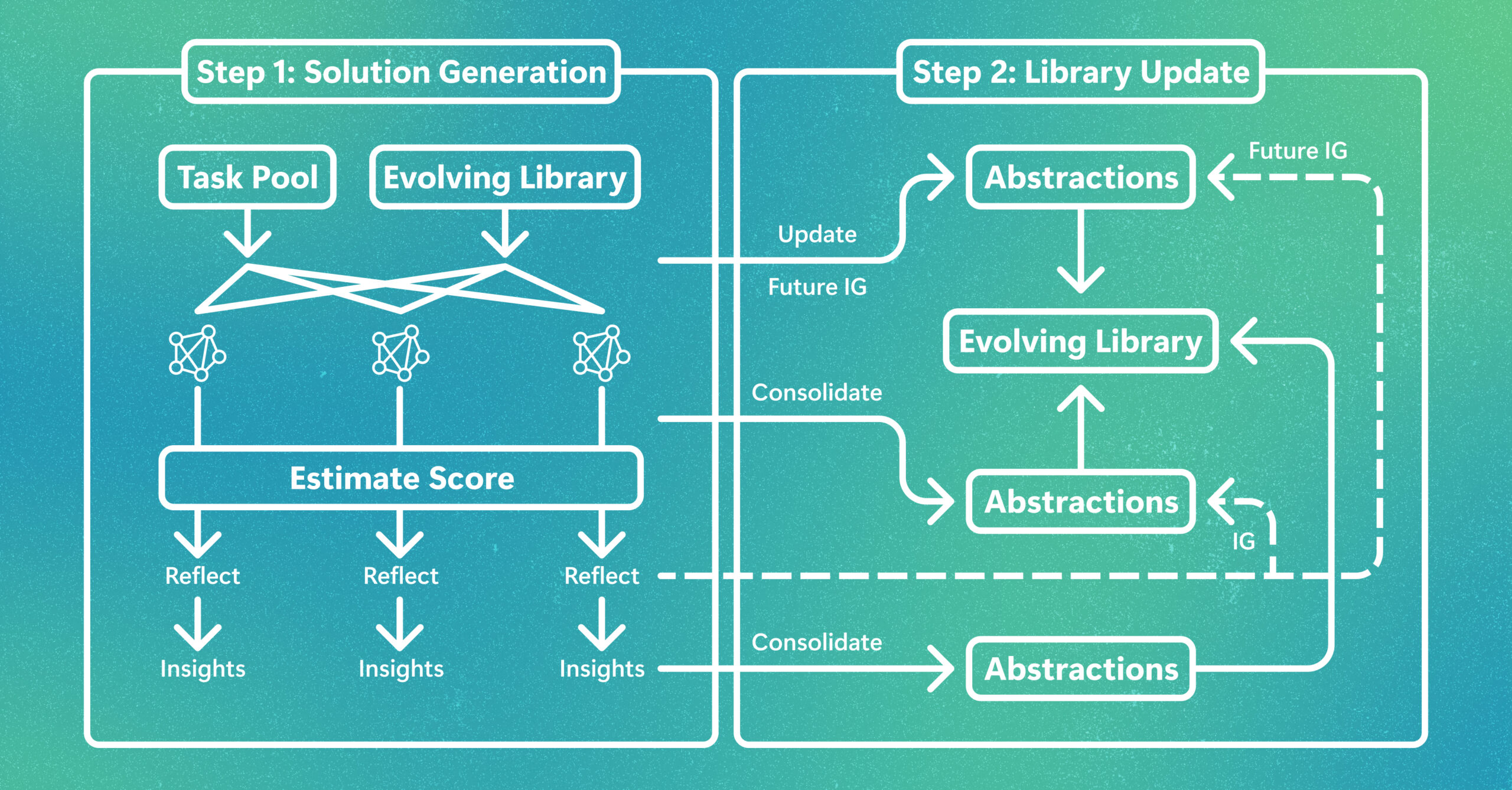
LLMs do not get smarter just by remembering more. EvoLib turns experience into evolving knowledge, taking reusable skills and insights that help models learn and adapt across tasks long after deployment. The post EvoLib: Turning experience into evolving knowledge appeared first on Microsoft Research.
We use cookies to run the site and, with your consent, for analytics and to show ads.
See our Cookie Policy.