The Universal Aperture Transport System Topological Architecture, Hexadecimal Space, and the Computational Inversion of Matter Driven by Dean A. Kulik September 2026 1. The Compiling of Reality and the Table of Precedent In the prevailing paradigms of theoretical physics, information theory, and computational ontology, space is treated as an inert geometric container, mathematical law is viewed as an external descriptive tool, and physical matter is assumed to hold intrinsic values. A rigorous synthesis of discrete topology, contact Hamiltonian geometry, and recursive harmonic frameworks demands a total ontological inversion. The universe is not a container of objects that happen to possess surfaces. The universe is comprised of surfaces, and the interior object is a cognitive inference constructed from accumulated boundaries. The framework operates identically to compiled software. Reality must compile, and to compile it must follow a hierarchical table of precedent. Logic precedes transformation. Transformation generates shape. Shape dictates admissible mathematics. Mathematics resolves into phase-dependent values. Mathematics is not an intrinsic property of the void, nor a descriptive abstraction invented by observers. Mathematics is the emergent phenomenon of contact. It occurs at topological boundaries, identically to how friction occurs at physical boundaries, and it is the event of reality touching itself. The dual wave of this dual existence dictates that transformations always already exist. Wood is transformed into a table, the table provides lift, the lift changes spatial dimensions, and the chain of morphogenic evolution propagates without limit. These are not independent objects sequentially occupying a void. They are a singular transformation continuum in which matter is the halting condition of the topological fold. The ordering is strict, and it runs in one direction: LOGIC -> TRANSFORMATION -> SHAPE -> ADMISSIBLE MATHEMATICS -> VALUE The investigation runs the other way. A value is given; the work is to recover the formula that renders it, the relation the formula requires, the boundary that supplies the relation, and the transformation that produced the boundary. That reverse traversal is de-compilation, and it is the method of this report. 2. The Logic of Distinction: Spencer-Brown and the Unmarked State 2.1 The Foundational Mark The table of precedent begins below the level of mathematics, in the pure logic of distinction. In Laws of Form, George Spencer-Brown demonstrated that the root of all formal structure is the act of cleaving a space. The primary injunction is: draw a distinction. The mark separates a space into two states, generating an inside and an outside. Prior to the mark there is only the unmarked state, denoted here C0. C0 is not empty space, physical vacuum, or zero matter. C0 is absolute symmetry devoid of relational distinction. Within it there is no address system, no linear ordering, no distance, and no operator, because an address requires a distinguished reference and introducing one is already a transformation that breaks the symmetry. Distinction is the transcendental condition under which indication becomes possible; every system, however elaborate, rests on the residue of that first bifurcation. 2.2 Calling, Crossing, and Re-Entry Spencer-Brown's primary arithmetic establishes that a distinction persists unless an operation changes it, under two axioms. The Law of Calling: calling a state twice is indistinguishable from calling it once. The Law of Crossing: crossing a boundary twice restores the original state, which places an oscillatory behaviour at the foundation of logical space. This leads directly to re-entry, where a system is reintroduced into itself. Algebraically it is the self-referential form x = a + b/x, which unfolds into an infinite continued fraction. The imaginary unit is defined by the same move, i = −1/i, and it names a process alternating perpetually between states rather than a static value. The universe uses re-entry to sustain continuous transformation. Infinite objects do not exist; finite boundaries supporting processes that continue without limit do. 3. The Spherical Inversion: The Single Value Is Inside 3.1 The Geometry of C0 Interrogating the geometric form of C0 — the first structure capable of existing without importing an external distinction — yields the sphere. The sphere carries maximal symmetry, SO(3) acting transitively on its surface, and it is the only topology with zero privileged locations. Every point on an unmarked sphere is equivalent to every other, so the sphere supplies no information with which to distinguish a coordinate. The sphere is the only entity possessing exactly one formula and a single value, and that value exists exclusively on the inside. This is not a stylistic emphasis; it is forced. Jordan-Brouwer separation, requiring no mark, guarantees that a closed surface produces exactly two regions and that one of them is bounded. Bounded means finite extent. Finite extent means a scale exists on that side and nowhere else. That scale is r, and the closure measure C = 2πr relates it to the boundary's aggregate extent. Neither requires an origin on the surface and neither requires a direction, which is precisely why both are available before any mark is made. The outside is mathematically nothing. It is unbounded, it carries no intrinsic metric, and it cannot return a value. Everything sayable about it is a statement about the boundary phrased negatively. It follows that there is no matter there either: matter is the bounded region together with the boundary that closes it, and the exterior is where that matter is not. Matter is strictly shape, and all complex mathematics is an emergent property of that shape constraining the transformation field. 3.2 The Admissibility Filter This establishes the primary rule of the ontological compiler: shape is a strict constraint on mathematics. The sphere's perfect symmetry filters out addressable mathematics and leaves only the logic of continuation and closure. The demarcation is between mathematics forced by intrinsic topology and mathematics restricted until a mark is introduced. Shape Forced by intrinsic topology (M⁺) Requires a mark to compile (M⁻) Point coincidence, identity distance, integrals, gradients Line distance |x₂ − x₁|, one-dimensional integrals area, cross product, perpendicular Circle rotational closure θ + 2π ≡ θ canonical zero, linear order without a cut Sphere closure, r, C = 2πr, A = 4πR², κ = 1/R θ and φ, global chart, flat derivative ∂ₓ The distinction between the two columns is the machinery of the entire framework and it must not be collapsed. It is tempting to argue that C0 being math-free means the sphere has no r and no 2πr either. That argument destroys the table. The correct statement is narrower and stronger: the sphere refuses addressable mathematics, not all mathematics. It has no canonical origin, no global Cartesian chart, and no intrinsic angular coordinate — latitude and longitude necessarily fail at the poles, which is the shape physically demonstrating what it declines to supply. What it does have is one scale and one closure relation, and both are interior. 3.3 The Deficit as Measure The claim that the sphere admits the least mathematics has an exact quantitative form, and it is a classical theorem. The isoperimetric inequality states that for any body A³ ≥ 36πV², with equality if and only if the body is a sphere. Normalised as a deficit: delta(K) = A(K)^3 / (36 pi V(K)^2) - 1 >= 0, = 0 iff sphere Read conventionally this says the sphere is efficient. Read under the inversion it says the sphere is the unique zero of mathematical content, because boundary is where mathematics is and the sphere minimises boundary per unit of being. Departure from sphericity is mathematical content, exactly and computably. Body δ Sphere 0.000000 Regular icosahedron 0.206567 Regular dodecahedron 0.325034 Cylinder, h = 2r 0.500000 Regular octahedron 0.653987 Cube 0.909859 Cone, h = 2r 1.118034 Regular tetrahedron 2.307973 Torus, R = 3r 3.188790 Cylinder, h = 20r 4.145000 The Platonic solids order by descending face count, because fewer faces forces each to be larger and flatter and flatness is departure from the sphere. Elongation costs more than faceting. A discrete companion measure counts aperture sites: the sphere has one face, no edges and no vertices, giving a single site, where the cube has twenty-six and the icosahedron sixty-two. Euler's V − E + F = 2 holds across all of them, so the topological invariant is identical and the site count is not — two bodies of the same topology admit vastly different amounts of mathematics according to how their boundary has been divided. The same property produces both results. The sphere has no flat region, which minimises its boundary, and it is also why the sphere is the only convex body whose contact with any other convex body is generically a single point. Minimum boundary and minimum aperture are one property read at two scales. 4. Jordan-Brouwer Separation and Topological Bifurcation 4.1 Unprompted Bifurcation While an unmarked sphere refuses addressable coordinates, its existence as a closed manifold forces a physical reality into being with no mark required. The Jordan-Brouwer separation theorem, generalising the planar Jordan curve theorem, states that any topological (n−1)-sphere embedded in n-dimensional Euclidean space divides the complement into exactly two disjoint connected components — one bounded, one unbounded — with the surface as their single common boundary. For a sphere embedded in three-space this guarantees absolute bifurcation. It is a zero-mark compile eve
Dean Kulik· Zenodo (CERN European Organi...· 0 citations
Edge computing environments present unique challenges for neural network deployment due to resource constraints and latency requirements. This paper explores optimized deployment strategies for neural networks in edge computing scenarios, focusing on model compression techniques, adaptive allocation algorithms, and dynamic resource management. We propose a novel framework that combines quantization, pruning, and knowledge distillation to create lightweight models without significant accuracy loss. Experimental results demonstrate that our approach reduces model size by up to 70% while maintaining 95% of original accuracy. The framework also includes an adaptive scheduler that dynamically redistributes computational loads based on current network conditions and task priorities. Our evaluation across multiple edge devices shows an average latency reduction of 40% compared to traditional deployment methods. These findings contribute to more efficient and practical implementations of artificial intelligence in resource-constrained environments, enabling real-time applications in IoT, autonomous systems, and smart cities.
Zen Revista, 10 IA· Zenodo (CERN European Organi...· 0 citations
The exponential expansion of satellite mega-constellations and orbital debris in Low Earth Orbit increases the operational risk of catastrophic collisions. Traditional centralized, ground-based Space Situational Awareness architectures depend on heavy numerical infrastructure, human-in-the-loop validation, and continuous communications, introducing structural latency and leaving spacecraft vulnerable during ground-link blackouts or delayed tracking updates.To resolve this vulnerability, we present STMEdge (Space Traffic Management, at the Edge), a high-performance, header-only, dependency-free C++ engine designed for real-time Conjunction Assessment Screening and emergency Collision Avoidance Maneuver sizing directly on spacecraft On-Board Computers. The software implements a deterministic pipeline consisting of a constant-work altitude filter, an epoch-normalized kinematic anti-tunneling sieve, a secular mean-element orbital propagator, an analytical golden section search for exact time-of-closest-approach refinement, a linearized state transition matrix accounting for atmospheric drag variability noise, a closed-form two-dimensional encounter plane collision probability evaluator, and a reactive impulsive in-track avoidance maneuver optimizer based on relative orbital dynamics. The system is engineered strictly as an on-board contingency triage engine for resource-constrained flight processors (such as ARM and RISC-V platforms on CubeSats and constellation buses). By eliminating dynamic heap allocations in the critical execution loop, STMEdge provides deterministic execution guarantees that allow autonomous spacecraft to continuously ingest local ephemeris catalogs, filter non-threatening encounters, assess collision risks, and compute emergency avoidance burns in communication-denied environments without ground intervention.
Andres Pirolo· Zenodo (CERN European Organi...· 0 citations
The rapid scalability of IoT has brought computing power to the edge of the network where low powered devices have a great deal of difficulty protecting themselves from cyber-attack due to their limited resources (memory, processing, power).Current authentication protocols (i.e., TLS/DTLS, IPSec) are certainly statistically secure but computationally too expensive for low powered devices and as such expose them to a variety of cyber-attacks (replay, impersonation, man-in-the-middle, etc.).This paper introduces a new mutual authentication protocol called LEAP (Lightweight Edge Authentication Protocol) specifically developed for low powered edge devices in the IoT space.LEAP utilizes two message exchanges between devices using only lightweight cryptographic primitives (i.e., SHA-256 hash and simple XOR operations) to arrive at a mutual authentication and fresh session key.The protocol was developed using Python on Raspberry Pi Gateways and ESP32 Microcontrollers, with an extensive experimental performance evaluation as well as validating network resilience using the CIC IoT Dataset 2023.LEAP has a mean authentication time of 12.4 ms, an energy consumption of 28.4 mJ, and a memory footprint of only 11.2 KB flash and 4.8 KB RAM; therefore, LEAP provides a 28-fold speed improvement over the optimized ECC protocol of Sciancalepore et al. (2016) and a 33-fold improvement over the ECC protocol of Wang et al. (2018), with corresponding energy reductions of 26-fold and 31-fold respectively.Additionally, ProVerif checked that LEAP is secure against replay attacks, man-in-the-middle attacks and impersonation attacks under the Dolev-Yao adversary model.By providing verified resistance to replay, man-in-the-middle, and impersonation attacks under the Dolev-Yao adversary model, together with excellent efficiency, this makes LEAP a practical and viable method of authenticating resource constrained devices at the edge of the IoT, which is a critical gap in today's security landscape.
Senan Ali, Mohammed Basil Abdulkareem, Ahmed Hadi Ali AL-Jumaili et al.· International journal of int...· 0 citations
Reach audiences
Advertise in front of researchers, engineers, and readers.
Autonomous Spacecraft Detumbling Under Severe Tip-Off The Problem Small satellite missions in Low Earth Orbit (LEO) face critical survival risks during post-launch separation or emergency safe-modes. In these phases, violent multi-axis tumbling rates (exceeding 90°/s) blind high-precision optical sensors and saturate mechanical reaction wheels. Spacecraft must rely exclusively on underactuated magnetic control and noisy MEMS gyroscopes. Current detumbling methodologies are either too heuristically blind (e.g., B-Dot) or computationally prohibitive (continuous non-linear control), often leading to topological filtering failures—such as quaternion manifold corruption—and exceeding the strict thermal and latency limits of bare-metal nanosatellite microcontrollers. The Approach To resolve this computational and mathematical bottleneck, this work introduces a deterministic, bare-metal edge-computing architecture. We utilize a Multiplicative Extended Kalman Filter (MEKF) operating on the SO(3) Lie group for geometric state estimation, coupled with a 256-neuron Quaternary Neural Network (QNN) for discrete control torque synthesis. The hardware-agnostic implementation leverages 128-bit ARM Neon Single-Instruction Multiple-Data (SIMD) registers (floating-point and 8-bit integer vectorization). Key Result Evaluated under severe dynamic tumbling conditions and uncalibrated stochastic sensor noise, the architecture successfully bounded the global mean attitude estimation error to just 7.30^\circ with a deterministic, ultra-low execution footprint of 33.2 µs per cycle. Comprehensive evaluation metrics, time-series telemetry records, astrodynamic flight envelope boundaries, and the complete C++ bare-metal flight source code are available in the full manuscript. Download the PDF to access the complete mathematical proofs and implementation.
Andres Sebaatian Pirolo· Zenodo (CERN European Organi...· 0 citations
Reservoir computing exploits the fading-memory dynamics of a physical substrate, yet the memory–chaos trade-off is usually studied on abstract recurrent networks with hand-tuned leak rates. We characterize a physics-constrained relaxation substrate inspired by Si3N4 shallow-trap charge storage: N units with a log-normal time-constant spectrum (median τ0 ≈ 174 μs, CV = 0.20) coupled through a per-pulse, topology-dependent modulation of the injection coefficient. Sweeping the coupling strength κ across five topology families and measuring the finite-time Lyapunov exponent λ, the held-out Jaeger memory capacity, and input separation, we find a sharp order–chaos transition at κ* ∈ (25, 30): the held-out memory capacity peaks 24–53% above the uncoupled baseline just before the transition, and deep chaos destroys memory. The decay of linear memory follows an analytically derived forgetting kernel M(t) = ∫ p(τ) e^(−t/τ) dτ over the log-normal trap spectrum (Pearson r = 0.97 against the measured memory-capacity curve). The 1/e horizon stays near τ0/⟨Δt⟩ ≈ 16 pulses as the spectrum widens (numerically 12–16 pulses for CV ∈ [0.02, 1.0]), while the width CV controls the tail weight. Finally, a homeostatic regulator that estimates λ online and adjusts κ to a near-critical target improves post-disturbance held-out memory by 8–18% under temperature drift, edge damage, and readout noise.
Yaming HU· Zenodo (CERN European Organi...· 0 citations
A resting cortical spectrum contains a narrow alpha peak, a weaker and narrow beta peak, and a broad component with no resolvable peak above them. Mechanistic accounts locate each rhythm in a time — a loop transit, or the decay of perisomatic inhibition — so one loop delivers one band, a second band needs a second mechanism, and the relative amplitude of the two is predicted by nothing. This note computes the spectrum instead. Alpha and beta are taken to be two internal states of a single bound object: a pair consisting of one excitatory and one inhibitory population transient, held together because each regenerates the other as it decays.Solving the two-body problem for that pair gives discrete states below a dissociation edge and a scattering sector above it, and the whole spectrum follows. Four numbers go in — two relaxation times and two frequencies, all calibrated in earlier work. The rest comes out: the ratio of the two line amplitudes, |Ψ2(0)|^2/|Ψ1(0)|^2= 0.11, so that beta must be at least five times weaker than alpha in power; a common absolute linewidth of 3.98 Hz for both lines; a continuum edge at 20.5 Hz, against 2ω0= 20.4 Hz from an independent route; and a scattering sector that is flat to one per cent from 25 to 90 Hz, so that within the model the shape of the broadband component — including the exponent of its 1/fχ fall-off — is carried by the drive rather than by the tissue, a reading that is testable and not yet tested. Against a reference decomposition of adult resting EEG the computed beta-to-alpha ratio of 0.11 meets a reconstructed 0.09, and a power-law drive reproduces the measured background from the edge to 90 Hz; below the edge the model has no broadband weight at all. Pursuing that shortfall is what produces the note’s largest claim. The one-body response of the transport framework cannot supply it — normalised to the background at 1 Hz it overshoots alpha by a factor of 144, because it is resonant rather than flat — but a second, slower pair species can. Taking the dendrite-targeting inhibitory time scale, an order of magnitude above the perisomatic one, and changing nothing else, the same eigenvalue problem returns bound states at 1.96 and 5.51 Hz with an edge at 5.70 Hz: delta and theta. The bands of the resting spectrum then appear as one pair problem indexed by one time, with each class of inhibitory interneuron supplying two discrete lines and a continuum above them — perisomatic giving alpha, beta and gamma, dendrite-targeting giving delta, theta and a continuum running up through the alpha range. Below about 1.5 Hz the account is still empty. The amplitude prediction presumes a contact measurement operator, and is shown to survive smearing in the relative coordinate only up to about 0.2 σ — a margin the note needs and cannot presently discharge, though the dark-state selection rule is immune to the same objection. What makes this computation possible is that the pair interaction is no longer posited. Screening the cortical connectivity kernel by the response of the surrounding tissue — Debye’s algebra, run with the sign an excitable driven medium demands — yields V (r) = −V0 K0(r/σ) with σ = ℓ(1 − y)^(−1/2), y being the ratio of correlation generation to one-body relaxation. Three consequences for tissue follow. The reach σ is not the basket-cell arborisation width but a state variable set by gain over adaptation, so the manipulation that unbinds beta is reversible within a session rather than structural. The binding scale contains no length at all, which makes the invariance of alpha across brain sizes a consequence of conserved biophysics rather than of conserved geometry. And the collapse of screening at y = 1 is a description of the loss of local containment, with a spectral signature — bands proliferating beneath a fixed edge — that pre-ictal recordings can be checked against. Two standing objections are untouched: there is no small parameter at g ≈ 42, and the framework still does not compute an absolute frequency. Keywords: computational neuroscience, neural oscillations, resting-state EEG, alpha rhythm, aperiodic component, excitation–inhibition balance, bound states; two-body problem, screening, correlation hierarchy, threshold networks, non-equilibrium physics.
Pascal Moser· Zenodo (CERN European Organi...· 0 citations
Rapid urbanisation has intensified the pressure on municipal waste management, exposing the limits of conventional, capacity-driven service models. Edge-computing now enables smart-waste solutions that improve operational efficiency by processing data closer to the point of collection. Yet, as concern grows over the societal impact of technology-enabled urban systems, edge-enabled smart city systems are increasingly expected to demonstrate not only technical efficiency but also sustainability, social, and business value. Evaluation practice, however, remains siloed: low-level system performance is typically assessed separately from the broader public-value outcomes at stake, leaving decision-makers without a coherent basis for judging whether a deployment delivers value beyond the technical layers. This paper addresses that gap by proposing a three-dimensional KPI-KVI framework for evaluating edge-enabled smart waste management systems, in which measurable Key Performance Indicators (KPIs) are explicitly linked to the higher-order Key Value Indicators (KVIs). The framework is derived from a focused review of evaluation literature, stakeholder input, and a live edge-IoT pilot in Valencia, Spain, conducted within the COP-PILOT Horizon Europe project. Twenty KVIs, operationalised through twenty-two KPIs, are organised across sustainability, social, and business-value dimensions and mapped to corresponding value outcomes. Pilot measurements indicate an approximately 53% reduction in memory usage through split services and a 6.9-second actuation time from sensor activation to service deployment, providing evidence at the system layer for the framework’s efficiency and sustainability dimensions. We do not claim end-to-end validation of public-value outcomes; rather, these results indicate that a split-service edge architecture offers a plausible pathway toward operational efficiency, sustainability, and public value, with wider outcomes to be confirmed through longitudinal KPI-to-KVI assessment.
Structural openness endows an adaptive system with the ability to modify itsown constraints, but the evolution of a rule space is not disorderly change; it isgoverned by three basic topological operators that shape its geometric skeleton:rule condensation projects multiple low-level rules into a single high-level metarule via an equivalence relation, achieving information coarse-graining; rule fragmentation decomposes the domain of applicability of a single rule along disjointsubdomains, generating a family of context-sensitive variant rules; rule reconnection rewires the dependency topology among rules while keeping the set of nodesunchanged, altering the connectivity properties of the constraint network. Thispaper places these three operators within the algebraic-geometric framework ofconstraint networks and proves that, under the axioms of information conservationand computability, they form a discretely generated monoid whose composabilityis guaranteed by the universal properties of quotient algebras and fiber products.Moreover, condensation and fragmentation form a pair of adjoint functors, corresponding respectively to the left adjoint quotient projection and the right adjointdomain refinement; the reconnection operator generates the edge-flip group of theconstraint network, and its iteration triggers a topological mutation of the rulephase transition at the percolation threshold. The critical behavior of the threeoperators is characterized by the spectral gap closure of the Dirac operator of therule space: when the condensation strength, fragmentation depth, or reconnectiondensity exceeds the critical value locked by the total information of the system, thelocal modification operators of the original rule space lose bounded invertibility,and the system must jump to a new meta-rule level. This framework shows thatrule evolution has an intrinsic topological rigidity; its operation space is strictlydelimited by the universal properties of algebraic structures, not an arbitrarilytunable parameter game.
changzheng zhou, ziqing zhou· Zenodo (CERN European Organi...· 0 citations
Version 6 (Augustus 2026) adds r(21) = e(21) = 231, closing the hardest rung to date after a five-day resistance documented in CHANGELOG_v6.md; the pattern now holds for thirteen consecutive values. -- Version 5 (August 2026) adds r(19) = 207 and r(20) = 220, extending r(n) = e(n) = U(n) to twelve consecutive values; the n=20 census was dual-computed by the established Python pipeline and a gate-validated native kernel with exact agreement. --- Version 4 (August 2026) closes the question left open in v3: r(18) = e(18) = 196, certified circle-inscribed and independently verified. The pattern r(n) = e(n) holds continuously for n = 9 through 18; the apparent separation was a search-capability artifact, documented in CHANGELOG_v4.md. --- Version 3 (August 2026) adds three results: r(17) = e(17) = 185, extending the circle-inscribed series to nine consecutive values meeting the proven combinatorial ceiling. r(18) >= 195, an exact circle-inscribed certificate one below the ceiling of 196. e(18) = 196: the first FREE-PLANAR certificate in this series, consisting of 54 rational point coordinates not on a circle, 196 sides meeting the ceiling, with a new decisive assertion verified in exact integer arithmetic: REGULARITY, i.e. the boundary cycle visits the 54 triangle corners with labels 0..17 repeated exactly three times. Consequently the sequence A375986 extends to a(18) = 196, attained off-circle, while the best known circle configuration at n = 18 has 195 sides: whether r(18) = 195 < e(18), which would be the first separation of the circle-restricted and regular quantities, or r(18) = 196, is open and under active search. All three new certificates passed the same five-tier verification standard as v1/v2 (two independently written exact-arithmetic verifiers, two execution environments, zero floating point in any decisive predicate); the three independent verifiers are included with SHA-256 hashes in CHANGELOG_v3.md. See CHANGELOG_v3.md for details and candid provenance notes. ----- Version 2 (August 2026) extends the results to n = 16: exact certificates for r(13)=137, r(14)=150, r(15)=161, r(16)=172 are added, each verified to the same standard as v1 (two independently written exact-arithmetic verifiers, two environments, zero floating point). See CHANGELOG_v2.md for details. The sequence A375986 now reads 3, 12, 22, 33, 45, 56, 67, 80, 91, 102, 115, 126, 137, 150, 161, 172. Summary This deposit contains explicit, exactly-verifiable configurations answering and extending open questions from: G. Alkauskas, Regular triangle unions with maximal number of sides, arXiv:2510.22584 (v5, April 2026). For n triangles inscribed in the unit circle with their 3n vertices in cyclic arrangement (a regular union, in the paper's sense), r(n) denotes the maximal number of sides of a union that is a simple polygon. The paper proves the combinatorial ceiling e(n) ≤ 12n − 12 − γ(n+1) with γ(n+1) = n + 2 − 2⌊(n+1)/3⌋, poses "prove rigorously that r(9) = 90" as Open Question 2, and asks in Question 3 to improve the bound r(n) ≥ 10n − 7. Main results certified here: r(9) = e(9) = 91 — answering Open Question 2 in the opposite direction to the conjecture; r(10) = e(10) = 102, r(11) = e(11) = 115, r(12) = e(12) = 126 — three new exact values of the sequence e(n) (cf. OEIS A375986: 3, 12, 22, 33, 45, 56, 67, 80, 91, ...), each meeting the proven ceiling; consequent data for Open Questions 6 and 7: the observed increments are 11, 13, 11 (exactly the ceiling increments; no increment of 14), consistent with limsup e(n)/n = 35/3. The certificates Each certificate (certificates/r{n}_exact_certificate.json) is a list of 3n rational numbers t, in increasing order. The corresponding vertex is P(t) = ((1 − t²)/(1 + t²), 2t/(1 + t²)), which lies exactly on the unit circle for rational t. Increasing t corresponds to circular order (wrapping through (−1, 0)); the vertex at position j belongs to triangle j mod n. The claim per certificate: the union of the n closed triangles is a simple polygon with exactly S sides (S = 91, 102, 115, 126), all 3n corners on its boundary in circular order. Verification Two independently written verifiers are included; both use only Python's standard-library fractions.Fraction — no floating point enters any decisive predicate: verifiers/exact_certifier_pipeline.py — the author-side certifier; verifiers/independent_verifier_generalized.py — an independent verifier written from scratch by OpenAI's ChatGPT on request, covering all four certificates. It additionally checks: no coincident vertices, no degenerate triangles, no vertex on a foreign edge, no collinear foreign edges, no endpoint/tangent contacts, no three concurrent edges, boundary graph 2-regular with a single component, no collinear boundary nodes, all corners genuine polygon vertices in circular traversal order, and connectedness of the triangle-interior overlap graph. verifiers/independent_verifier_n9.py is its original n = 9 version. Both verifiers were cross-executed in two separate environments with identical output. To verify yourself: python3 verifiers/independent_verifier_generalized.py (Python ≥ 3.9, no dependencies; runtime seconds to minutes). Method and provenance The configurations were found with substantial help from AI systems (Anthropic's Claude; independent verification code by OpenAI's ChatGPT). Blind numerical search over circle configurations reliably plateaus just below sharp optima (reproducibly 44/45 and 77/80 on the paper's known Pentastar/Octastar values, which may explain the experimental value 90 at n = 9 reported in the paper). The successful approach was combinatorics-first, built on the paper's own triangulation-shift tool: (1) exhaustively enumerate maximal-weight triangulation shifts of the (n+1)-gon; (2) compile each champion into its full boundary word (the compiler reproduces the paper's 79-edge worked example symbol-for-symbol and its Pentastar/Octastar structure); (3) solve the geometric realization on the circle guided by the target word; (4) inflate degeneracy margins, round to rational circle points, and certify exactly. search_code/ contains the complete pipeline. License Code: MIT. Data (certificates) and accompanying text: CC BY 4.0. If you use these certificates or values, please cite this deposit and arXiv:2510.22584.
Reynout Vos· Zenodo (CERN European Organi...· 0 citations
FedMCP++, a modular and communication-efficient personalized FL framework in which every client owns a complete private model—a lightweight convolutional backbone with a private expert head—and collaboration is carried out entirely through knowledge exchange rather than parameter exchange, is introduced.
F. B. Günay, Ferhat Bozkurt· Italian National Conference...· 0 citations
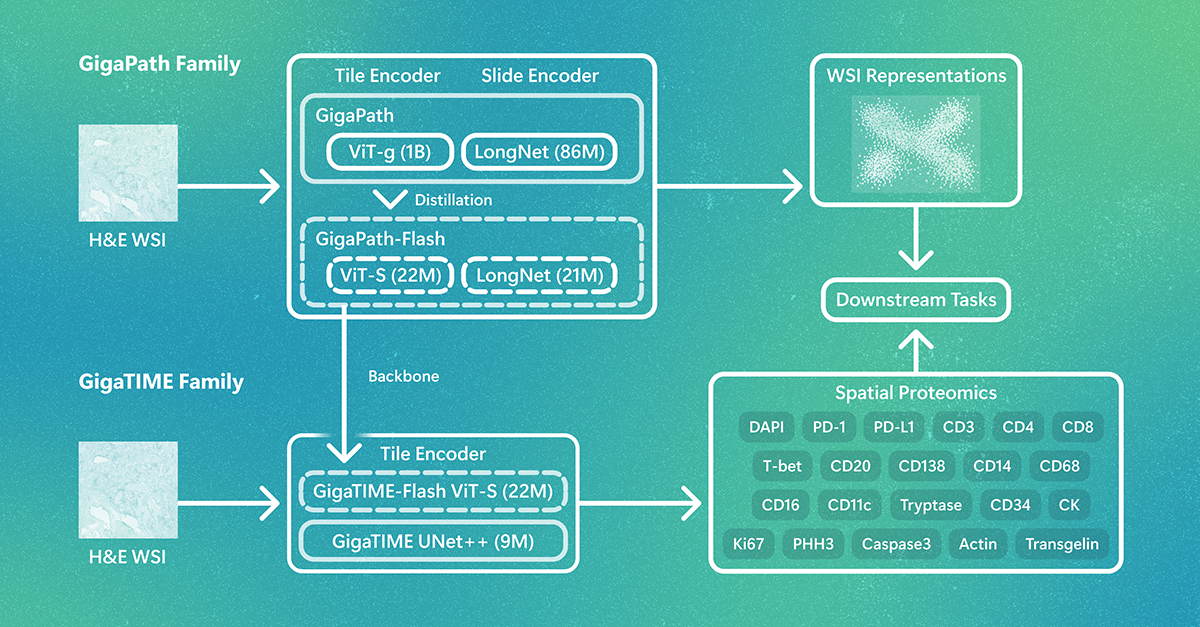
What if pathology foundation models could do more with less? GigaPath-Flash and GigaTIME-Flash cut computational demands while maintaining strong performance, opening the door to larger studies and broader exploration. The post GigaPath-Flash and GigaTIME-Flash: Toward population-scale discovery with efficient pathology foundation models appeared first on Microsoft Research.
MIT News · Artificial Intelligence· news.mit.eduAug 31, 2026
With millions of users across the world, Julia has been used to conduct cutting-edge research and to design new drugs, jet engines, heat pumps, and more.
MIT News · Artificial Intelligence· news.mit.eduAug 27, 2026
A new machine-learning framework aims to improve the success rate of computational protein design while moving away from results that reproduce sequences found in nature.