Skip to content

Dynamic Harness Search: Building Multi-Agent Systems Per-Query via Prediction

Oct 2026 · 0 citations · 41 references
Computer Science

TL;DR

This work introduces SHIFT, which moves execution out of the per-query search loop and shows that choosing structure, instructions, and tools jointly beats choosing only instructions or only tools by up to 9.1 percentage points, and that learned value selection identifies more accurate harnesses with lower execution cost from candidate pools.


Abstract

Agent harnesses specify the roles, instructions, tools, and communication structure used to solve a task, and the right harness depends on the query. Because the value of each design choice is observable only through execution, tailoring a harness to each query has required either executing alternatives at inference time or costly manual design. We introduce SHIFT, which moves execution out of the per-query search loop. A local LLM architect learns a policy over harness-building actions from search, and a value function that predicts, from measured executions, a utility balancing accuracy against execution cost. For each query, Monte Carlo tree search uses these predictions to construct a harness. Across 9,193 tasks in six benchmarks, from math to document and general-assistant tasks, with a Gemini 3.5 Flash executor, SHIFT attains the highest mean accuracy, about 80%, outperforming 17 baselines that span prompting, prompt optimization, and workflow search, and exceeding the strongest baseline by 7.2 percentage points. A cheaper mode of SHIFT also attains a higher mean accuracy than every baseline while using 32% fewer execution tokens than the strongest baseline. We further show that choosing structure, instructions, and tools jointly beats choosing only instructions or only tools by up to 9.1 percentage points, and that learned value selection identifies more accurate harnesses with lower execution cost from candidate pools.
View source

Similar papers

Multi-Agent System Search via Active Substructure-aware Policy Optimization

ASPO introduces an Adaptive Query-Selection Mechanism (AQSM) that focuses training on queries at the policy's competence boundary: those it can solve but not yet reliably, and introduces substructure-level rewards that measure output-quality gains within each action's descendant subgraph.

Bei-Cheng Xu, Bo-Wen Fan, Wei Qian et al. · 0 citations
#natural language process... Preprint Oct 2026

Harness-Search: Guiding Long-Horizon Search through Multi-Agent Coordination

Harness-Search is introduced, a multi-agent search harness to reduce the local errors propagating across subsequent exploration, evidence curation, and termination decisions, and improves both retrieval and answer generation under the same policy backbone.

Shanyong Wang, Zhen-Wen Ji, Lei Jin et al. · 0 citations
Preprint Aug 2026

AutoSaddler: Automatic Harness Optimization with Durable Updates from Agent Execution Traces

The proposed AutoSaddler, an automatic harness optimization framework that formulates harness improvement as an offline learning problem and iteratively updates the harness using failure signals from mini-batches, suggests that automatic harness optimization is a promising path toward more performant and reliable agent...

Sungho Park, Wonjoong Kim, Rongyuan Tan et al. · 17 citations · ⚡1

Related blog posts

MIT News · Artificial Intelligence Nov 17, 2026

Learning the language of machine learning

By studying the computational foundations of language learning, Associate Professor Jacob Andreas builds intelligent systems that can communicate effectively with humans.

Microsoft Research Blog Nov 16, 2026

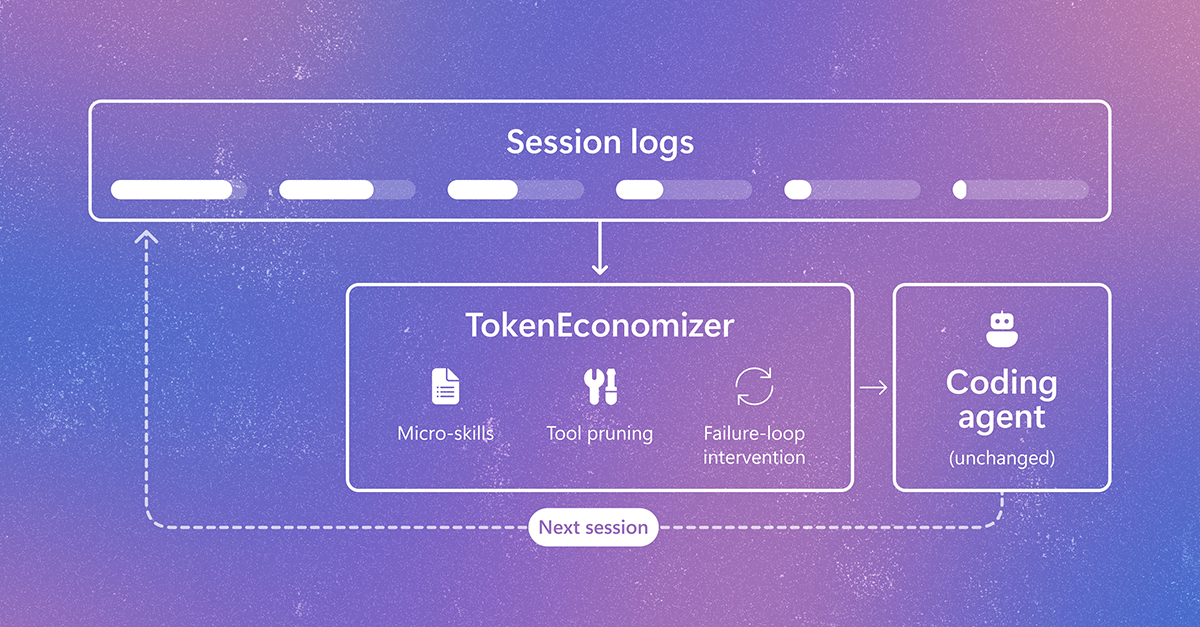
TokenEconomizer: Learning from Experience to Make AI Coding Agents More Efficient

AI coding agents are increasingly help developers fix bugs and build features largely on their own, but every interaction with their models consumes tokens. In each session, an agent sends instructions, tool descriptions, and session history to its model. Most efforts to reduce this cost focus on individual tasks. Yet developers return to the same […] The post TokenEconomizer: Learning from Experience to Make AI Coding Agents More Efficient appeared first on Microsoft Research.

We use cookies to run the site and, with your consent, for analytics and to show ads. See our Cookie Policy.