Generative Adversarial Networks and Image Synthesis
TL;DR
FedMuse is proposed, a privacy-aware federated framework for multi-style text-to-image art generation, in which distributed clients collaboratively train a shared generative model while keeping their private art data local, and an adaptive privacy regularizer is introduced to reduce memorization risk while maintaining visual quality and prompt consistency.
Abstract
Text-to-image generation has rapidly advanced the creation of digital artwork, yet most existing models rely on centralized training pipelines that require collecting large-scale image–text pairs from artists, design studios, or online communities. Such centralized practice raises serious privacy, ownership, and style leakage concerns, especially when local datasets contain identifiable artistic signatures or proprietary visual assets. To address this problem, this paper proposes FedMuse, a privacy-aware federated framework for multi-style text-to-image art generation, in which distributed clients collaboratively train a shared generative model while keeping their private art data local. The proposed framework decomposes the learning process into three coordinated components: a global semantic alignment module that captures cross-client text–image correspondence, a local style adapter that preserves client-specific artistic characteristics, and a privacy-calibrated aggregation mechanism that suppresses sensitive style leakage during model update exchange. To further improve multi-style generation, we design a style-disentangled federated optimization algorithm that separates content-relevant knowledge from client-private stylistic representations, allowing the global model to generalize across diverse artistic domains without directly absorbing private local styles. In addition, an adaptive privacy regularizer is introduced to reduce memorization risk while maintaining visual quality and prompt consistency. Experiments on real-world text-to-image art datasets demonstrate competitive generation quality, stronger personalization, and improved empirical resistance to membership and style-leakage attacks. Because the calibration statistics are data-dependent, FedMuse does not claim a certified end-to-end differential-privacy budget. The results suggest that privacy-aware collaboration can be a practical direction for distributed AI art generation.

Client-Resolved Generation (CRG), a genera- tion interface that separates server-side generation from the lexical realization of input-derived content, is introduced, which provides a practical interface for privacy-sensitive cloud LLMs by reducing plaintext exposure across both input and output pathways while preserv-...
Jeongho Yoon, Chanhee Park, Yong-Chan Chun et al.· 0 citations
A non-invasive model fingerprinting framework based on collapsed generation, a phenomenon where certain input conditions produce highly consistent images across multiple stochastic seeds, is presented, establishing collapsed generation as a reliable intrinsic evidence source for non-invasive diffusion model ownership v...
Yuanmin Huang, Chen Chen, Geng Hong et al.· 0 citations
Visual Internet-of-Things (IoT) cameras and institution-controlled edge gateways increasingly collect artwork images in museums, galleries, and heritage sites. Centralizing these images can expose collection contents, exhibition layouts, and contextual information. This paper proposes FedArtSense, a privacy-preserving...
Shu-Yi Wang, Bao-Ping Wang· Italian National Conference...· 0 citations
FedRAT is proposed, a privacy-preserving federated framework that couples paired paraphrase consistency, generator-family auxiliary supervision, differentially private client updates, and loss-dependent aggregation within a unified detection setting.
Zi-Hao Zhang· International journal of pat...· 0 citations
Diffusion-based text-to-image (T2I) models are increasingly used for visual content creation, making their generation capability a valuable intellectual property asset. However, this capability is vulnerable to black-box output-based distillation, where an adversary queries the service, collects prompt-image pairs, and...
Zi-Han Wang, Bo-Heng Li, Rui Zhang et al.· 0 citations
DiSCO is proposed, a zero-shot, strictly black-box defense that operates entirely at the prompt level as a plug-and-play module, requiring no model retraining, fine-tuning, or access to model internals, and can be readily applied to any text-to-image system without necessitating any changes to the model itself.
Tong Zhang, M. Alfarra, Carlos Hinojosa et al.· 0 citations
Training AI agents with reinforcement learning can be challenging because their tools, context, and decision-making are managed by complex frameworks. Agent Lightning connects existing agents to RL training, making it easier to improve them without rebuilding them. The post Agent Lightning v1.0: A 3,500-Line Lightweight Agentic RL Framework for Training Agents with Real Harnesses appeared first on Microsoft Research.
MIT News · Artificial Intelligence· news.mit.eduOct 6, 2026
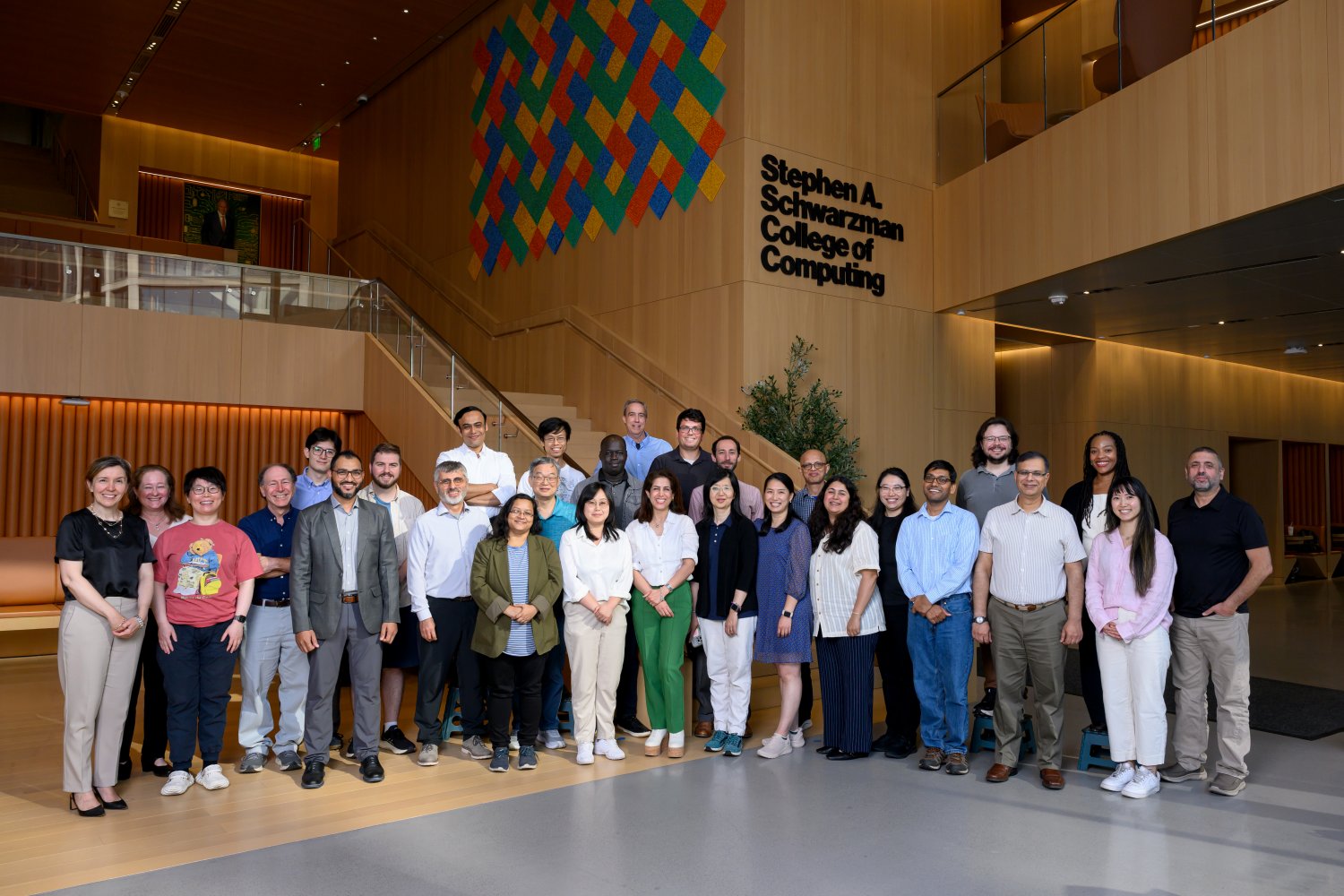
A weeklong summer workshop brought higher education faculty to campus to explore how AI and machine learning materials can be adapted for their classrooms.
We use cookies to run the site and, with your consent, for analytics and to show ads.
See our Cookie Policy.